


Understand Xingyuan Dynamics
Precautions for the use of Anilox roller
Time:
01 Sep,2021
On the surface of the Anilox roller are evenly distributed many tiny concave holes with the same shape, which are generally called "inking holes". It is these ink holes that play the role of ink storage, ink distribution and quantitative ink transfer during printing. Ink holes are generally carved along the direction of 45° to the axis. The partition wall between the ink holes is called "mesh wall", and the area of the net wall is related to the shape of the ink holes.
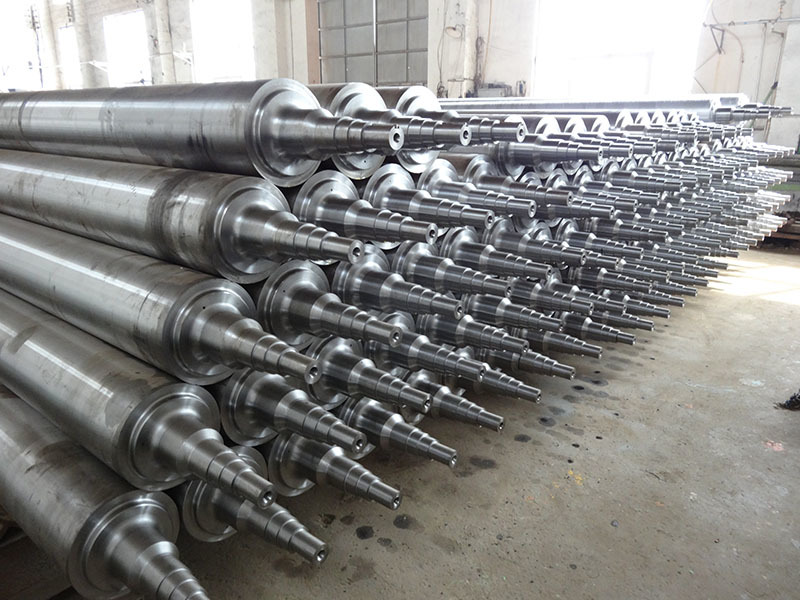
Anilox roller is a very precise mechanical part, and it is also the core component of the flexographic printing machine. Therefore, you must be careful during use to avoid bumps or damage. When installing or uninstalling Anilox roller, be sure to apply force evenly, handle it gently, and install the Anilox roller firmly into the supporting groove or remove it from the printing machine. During the printing process, the pressure between the doctor blade and the Anilox roller and the rubber roller and the Anilox roller should be as small as possible to reduce the wear of the Anilox roller. After stopping, the Anilox roller must be separated from the rubber roller, otherwise, the Anilox roller will bend and deform due to long-term unidirectional force, which will cause uneven ink transfer of the Anilox roller. In addition, after each printing, the Anilox roller must be carefully cleaned in time to prevent the pigment particles in the ink from drying up in the ink hole, causing the ink hole to block and affecting the printing production.
During the storage process, the Anilox roller should also be protected to prevent the surface from being damaged or impacted by foreign objects. In addition, it should be placed in a special storage box to prevent the surface from being stained with oil, dust or dust.
There are also several aspects to pay attention to: For the chamber scraper system, the following aspects should also be noted:
① Use clean water to clean Anilox roller. The chamber scraper system generally has an automatic cleaning function. At this time, where does the cleaning water come from? Tap water or groundwater? Is tap water clean water? We might as well let the tap water flow through a 140 mesh filter, and soon we will find a lot of sand on the filter. Not to mention groundwater. These sand particles become the killer of Anilox roller;
②Regularly clean the metal plate holding the scraper. Open the metal plate holding the scraper, and you will see shocking things: ink residue, rust, impurities, etc., if these are not cleaned up in time, they are also the killers of Anilox roller;
③Ensure the sealing of the ink supply system, and it is best to install a filter device (120 mesh or 140 mesh) at the ink inlet, which is very necessary. For the ceramic Anilox roller, you should also pay attention not to be close to the heat source. Too high temperature will cause the ceramic layer of the ceramic Anilox roller to fall off. How well the Anilox roller is maintained can be judged by observing its appearance and inspecting it with a magnifying glass. A well-maintained Anilox roller has a clear surface, consistent color and gloss, no obvious stains, and no obvious scratches or damage when observed under backlight; while an improperly maintained Anilox roller has a fuzzy, dim surface and obvious stains, such as Scratches or damage can be seen in backlight. Observing under a high-power magnifying glass, it is clear at a glance whether the cells are clean or not. Manufacturers with conditions can also use a densitometer to detect and evaluate the density of the printed area, which can determine whether the Anilox roller is cleaned.
Discount,Anilox,roller,from,China,manufacturer,Cheapest,Anilox,roller,for,sale,near,me
Tag:
Scan added
Contact WeChat

Contact us
Address: Menzhuang Small and Medium-sized Enterprise Pioneer Park,
Zaoqiang County, Hengshui City, North Hebei Province
Fax: +86-318-8266560
Mobile phone:+86-138-3187-6497
Mobile phone: +86-137-3136-1896
Email: xyjx@xyshiftroll.cn
Copyright © 2020 Hengshui Xingyuan Machinery Manufacturing Co., Ltd. All Rights Reserved Powered by www.300.cn | SEO